Why a Hard Court Makes the Ball Feel Faster
Why a hard court makes the ball feel faster: learn how bounce, spin and surface affect a pass, then adapt your first touch to keep play controlled.
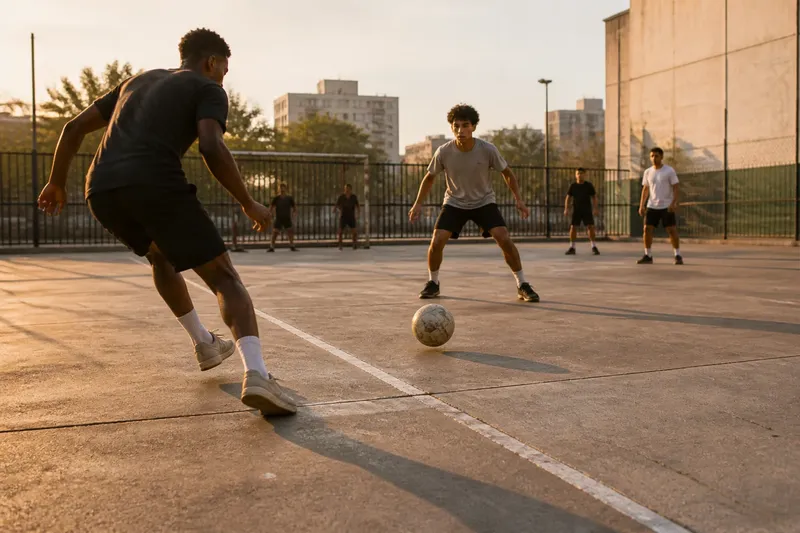
A hard court makes the ball feel faster because its firm surface can leave less time to judge a bounce and prepare the next touch. Why a hard court makes the ball feel faster is not just a question of pace: the ball, its pressure, spin, angle of impact and the condition of the ground all shape what happens next.
A pass that settles on rough grass may skip across paving. On a city court, reading the surface is part of reading the pass: the ball’s path matters more than a general expectation that hard ground always produces the same rebound.
The court’s response
Grass, packed earth, rubber and concrete each meet the ball differently. Concrete usually yields less than soft ground, but that alone does not determine the rebound. The ball’s construction and condition, the angle and speed of impact, its spin, and the particular surface all contribute to how it leaves the ground.
A smooth, firm patch may give a clean, immediate bounce. A seam, dust, grit, worn paint or shallow slope can alter the ball’s path or its contact with the surface. Even two areas of one court may behave differently, so “hard court” is a starting point for observation rather than a full prediction.
The result is not simply more speed. A low pass may keep travelling, while a ball with spin or a slight hop may take an unexpected line. The player feels urgency because there may be less time to set the foot and adjust to the ball’s actual arrival point.
A ball on a hard court is a little like a marble on a kitchen table beside one on a folded coat: the table gives way less, while the coat absorbs movement. It is only an analogy; a football’s rebound depends on the ball and the details of its contact with the ground.
Reading the ground
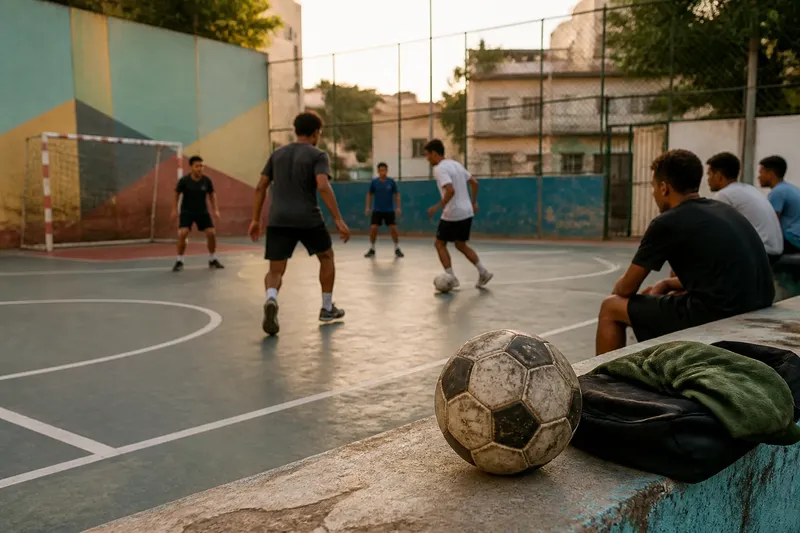
Players often notice the surface through their feet and the ball’s path. A short pass may rattle over slab joints; a ball crossing a painted line may hop differently from one travelling over bare concrete. Dust can affect footing, and grit or an uneven patch can make a bounce less predictable.
Before the game gathers pace, watch a few ordinary passes. Notice whether the ball stays low, rises, or changes direction after a seam. Look for loose grit, drainage channels and worn patches, then use those observations to avoid asking a first touch to do too much in an awkward spot.
If a pass is likely to skip, stay balanced with soft knees and keep room to adjust in either direction. A stiff, planted stance leaves less scope to respond when the ball arrives higher or wider than expected.
Shaping the first touch
On a hard court, stopping the ball dead is not always the most useful choice. A touch that leaves it too close can crowd the next action; a large cushion can send it into traffic. Often the aim is to guide the ball towards the next play while keeping it within reach.
A gentle inside-foot contact can angle the ball into space rather than send it straight back along its path. Meeting a pass slightly off-centre may change its direction and pace, though the result depends on the incoming ball and the contact. The sole can help when the ball is close and slow; on a quick, bouncing pass, it may be harder to control.
Move towards the pass early, then make a small adjustment as its bounce becomes clearer. A half-step, turned hip or foot placed across the ball’s path can provide room to guide it. Avoid committing to a touch before you can judge where the ball is going.
A touch near the line
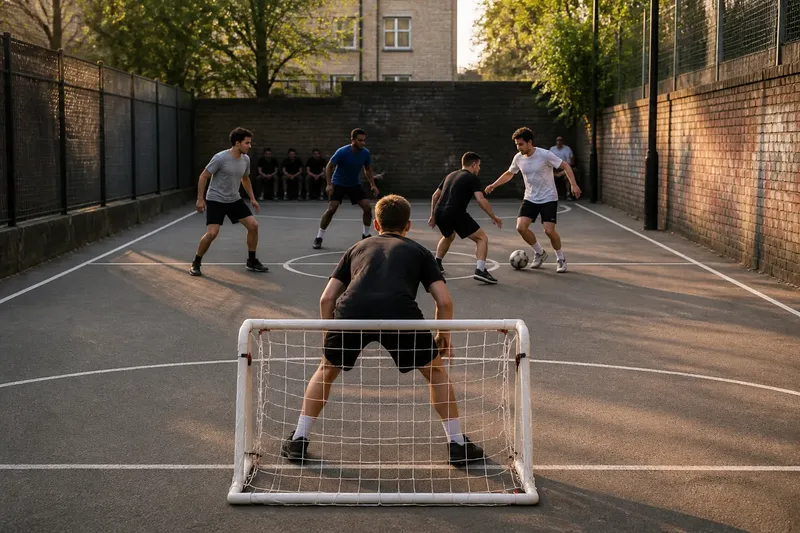
Imagine Sam joins an informal game on a compact public court after mostly playing on uneven grass. The hypothetical starting point is a firm pass aimed towards a painted line, where a raised paint edge and the ball’s particular bounce make the arrival uncertain. Sam waits for the ball to settle, and it hops into another player’s path.
On the next few exchanges, Sam watches passes cross that line and sees that their paths are less dependable there than across the smoother middle. When a teammate sends another ball towards it, Sam moves earlier, stays balanced and uses an inside-foot touch to redirect the ball away from the line. The expected observable result is a ball that remains available for a short follow-up pass; the trade-off is that Sam gives up the chance to turn immediately into the line’s uncertain bounce.
When a later pass reaches the smoother middle, Sam judges that bounce separately and directs the first touch forward. The practical change is not a new trick but a more cautious decision where the surface has been less predictable. The ball may still behave unexpectedly, so Sam keeps enough balance to adjust.
Keeping the game legible
A hard court does not require every pass to be short or cautious. The passer can choose a clear line and a pace suited to the distance rather than assuming the ground will slow the ball. The receiver can decide whether the next touch should control, turn or release.
If a defender is close, a sideways touch may open a lane. If there is space ahead, guiding the ball forward can keep the move flowing. If the bounce is uncertain, moving it away from a seam may be safer than trying to trap it on the awkward patch.
A brief call such as “turn” or “one more” can help a teammate anticipate the next action. In an informal game, that need not become a formal system; it is simply a way to share an intention before the ball arrives.
Questions about hard courts?
Why can a ball bounce differently on concrete?
Concrete usually gives way less than soft ground, but the rebound also depends on the ball, its pressure, spin, angle of impact and the surface’s condition. Seams, grit or worn areas can change the contact, so the result is not identical on every court.
Does a hard court always make a pass faster?
No. The pass’s pace and spin, along with the surface’s smoothness and condition, affect how it travels. A firm, smooth area may let it roll cleanly, while a rough patch or loose grit can interrupt its path.
How can I control a bouncing pass?
Move early, stay balanced and wait until the ball’s path is clearer before choosing a touch. Guide it towards useful space rather than trying to stop every pass abruptly, especially near seams or worn patches.
Should I use the sole on a hard court?
The sole can be useful when the ball is close and moving slowly. For a fast or airborne pass, an inside-foot touch may make it easier to guide the ball, though the best choice depends on the ball’s arrival and your balance.
Learning the surface
A hard court can make play feel hurried when a bounce leaves little time to adjust, but firmness alone does not explain every change in the ball’s path. The useful habit is to watch how this ball meets this patch of ground, then let that observation shape the first touch.
Why a hard court makes the ball feel faster is therefore a practical question about timing, not a rule that every pass will rebound sharply. Notice the seams, watch a few exchanges and adjust as the ball reveals its path; on the next patch of the city, the same pass may call for a different response.