A First Visit to a Neighbourhood Five-a-Side Game
A first visit to a neighbourhood five-a-side game becomes easier when you know where to stand, how to follow the play and when to join the conversation.
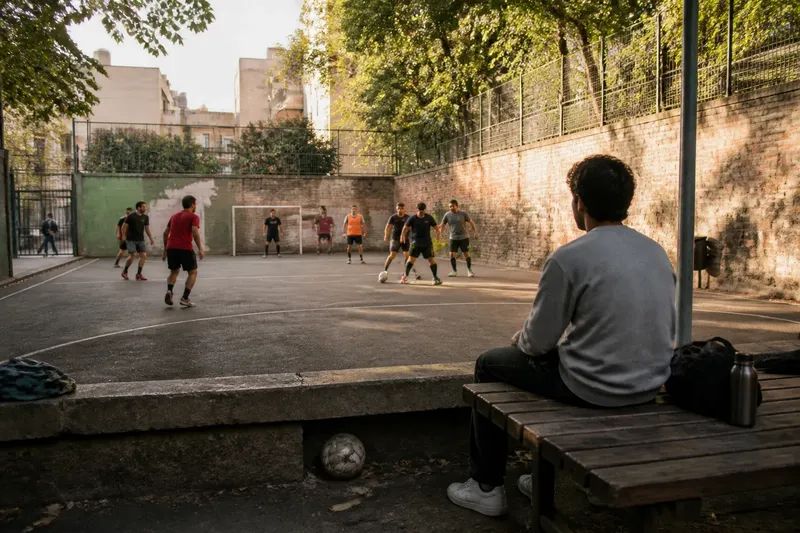
A neighbourhood five-a-side game is easiest to understand from beyond the touchline, where you can follow the movement without obstructing it. On a first visit, the court’s entrances, walls and pauses tell you as much about the gathering as the ball does.
Find a clear vantage
Choose an established spectator edge, such as a bench, a fence or a low wall, and keep the gate, goals and route to retrieve the ball clear. If people regularly pass behind one goal, stand farther back rather than treating the space as spare seating.
At an open court, notice how the pitch meets its surroundings. A path may run close to the boundary, while a wall can send the ball sharply back into play. Pick a place where you can see both ends without making players change their route around you.
Read the court’s shape
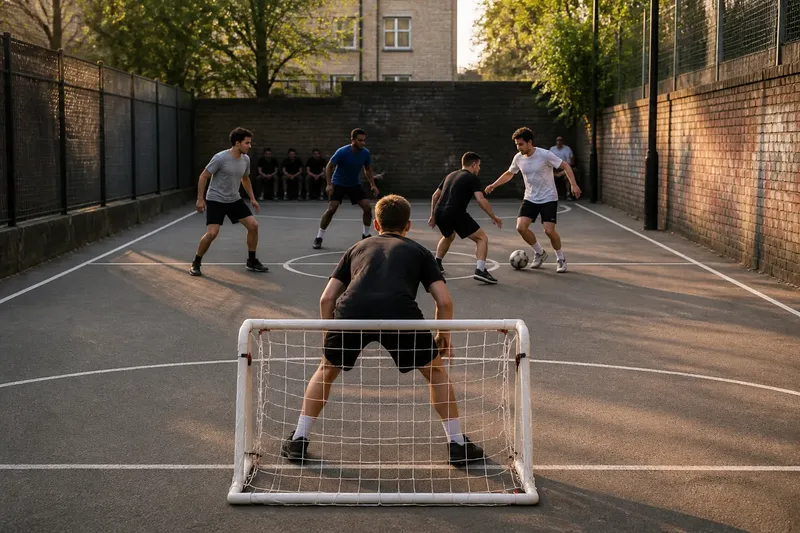
A compact pitch makes small movements conspicuous. A player without the ball may be creating a passing lane, while another holds space near the goal; following one player for a few passages can make those choices easier to see than trying to track everyone at once.
The surface and barriers also shape the game. A fence contains a wayward pass, and a hard wall can turn a clearance into a rebound. The court is less like a smaller copy of a stadium than a room with its furniture fixed: each boundary changes where people can move.
Notice the pauses
Rather than concentrating on who enters next, watch what the group does when play stops. Someone may fetch the ball, settle a disputed boundary or briefly speak to a teammate; those moments reveal how the players keep the game going and what matters to them.
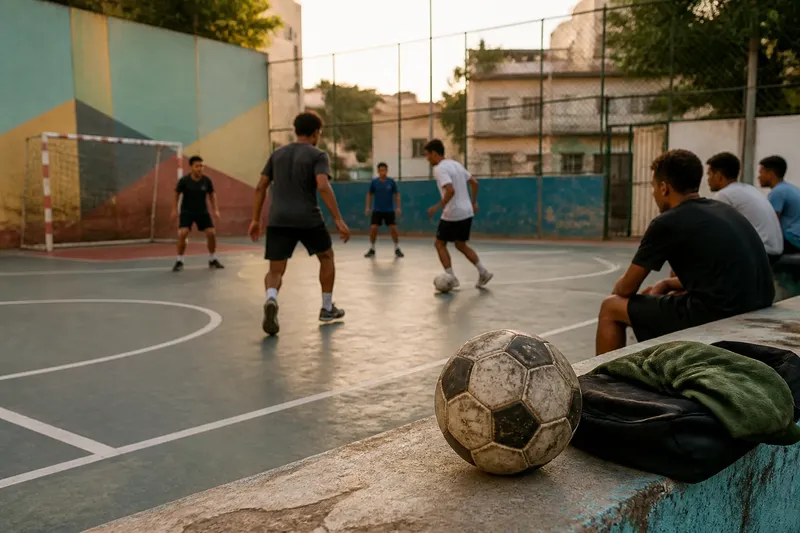
Imagine you arrive at an open court where a ball has rolled beneath a bench and play has paused. You stay beyond the boundary, point out where it went, and wait while a player retrieves it; the observable result is that the game resumes without you crossing into its path. If nobody notices your gesture, leave the ball where it is rather than entering during active play.
How do you join in?
Where should you stand?
Use a bench, fence or other established spectator edge, keeping the entrance and playing boundary clear. If the only open patch is a route players use, move farther away.
What if a ball comes towards you?
Stay outside the boundary and return it gently only when play has paused. If the ball is moving through an active passage, give the players room to collect it themselves.
How can you follow play without knowing the score?
Watch how players use the walls, cover open space and respond to pauses. If the score becomes relevant to the group, listen for the players’ own calls rather than guessing from their reactions.
When is it appropriate to ask to play?
Ask someone who is not in the middle of play whether newcomers can join, and accept the answer without stepping onto the court. If the timing is unclear, remain a spectator until a player invites you in or explains the arrangement.
Make room for others
Arriving quietly gives you time to understand the court without asking anyone to stop and explain it. Keep bags and drinks away from entrances, and leave the boundary open for players and anyone passing through.
A first visit to a neighbourhood five-a-side game need not involve joining a side. Notice how the court’s layout shapes movement, and how players handle a pause or a stray ball; those details offer a clearer sense of the place while leaving the game to the people playing.