Small Goals or Full-Width Goals for a Narrow Court?
Choosing small goals or full-width goals for a narrow court changes shooting angles, passing lanes and the match’s rhythm before the first kick.
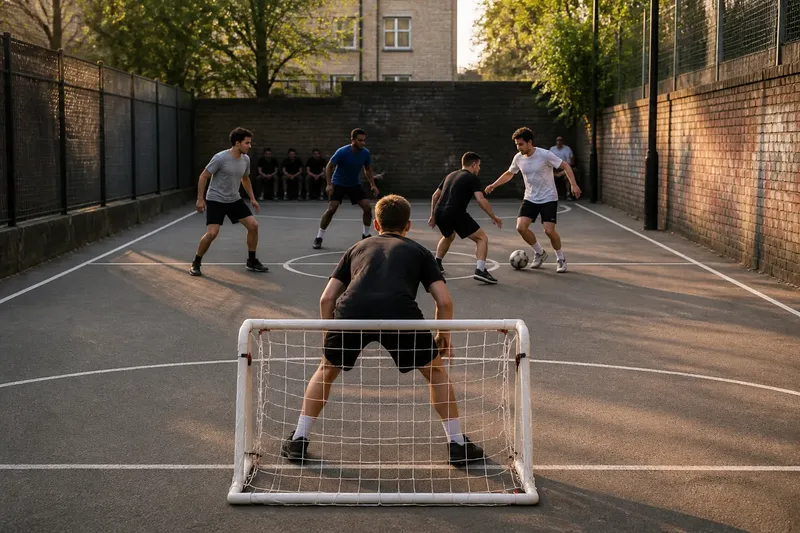
On a narrow court, goal width decides how quickly a promising attack becomes a shot. Small goals or full-width goals for a narrow court are not merely different bits of equipment: they shape where players look, how defenders protect space and whether a casual match feels patient or urgent.
A useful choice begins before anyone starts marking out the game. Think through the court’s shape, the number of players, the available goal frames and the kind of contest the group wants. Then treat the first match as a trial of the arrangement, not a verdict on anyone’s football.
What the width changes
With smaller goals, the target occupies less of the line. A player approaching from an angle has to be more exact, so a shot that feels obvious on a full-size target may instead call for another pass, a change of direction or a closer approach. The goalkeeper, if there is one, has less line to cover, while defenders can pay close attention to the route between ball and goal.
Full-width goals create a different invitation. More of the goal line is available, and a pass across the face of goal or a shot from a slant can feel viable. On a compact court, that can make attacks arrive quickly: a defender who shifts towards one side may leave another route open.
Neither arrangement automatically makes a better game. Small goals can reward combination play, but they may also produce cautious attacks if players see no useful shooting angle. Wider goals can prompt more attempts, yet they may leave the goalkeeper exposed to close-range shots and make defensive cover feel stretched.
Match the goal to the court
Start by looking at the space between the touchlines and the goal line, not at a goal in isolation. If the court is so narrow that a player can reach a shooting lane with little lateral movement, a broad target may make that lane too easy to exploit. A smaller target can ask the attacking side to create an opening rather than simply use the available width of the goal.
Consider the route players take to reach the ball as well. A goal set close to a wall, fence or boundary may leave little room for a keeper to move or for an attacker to turn. If a full-width frame fills most of the end of a tight court, the goal can dominate the game; a smaller target may preserve clearer movement around its sides.
Where players take turns in goal, ask how much of the match should depend on keeping a shot out. Small goals can make a keeper’s position easier to understand, though close shots still demand quick reactions. A broad goal can make positioning and communication more demanding, especially if the group is not used to defending together.
Use goals that are stable, intact and suited to the surface, and keep the playing area clear around them. Follow the equipment maker’s instructions and any local rules for the venue; if the frame or its placement raises a safety concern, choose another arrangement rather than improvising.
A week of decisions
A short routine over a week gives a group time to choose deliberately without turning a casual match into a committee meeting. The aim is to settle the practical details in advance, then leave room to adjust after players have experienced the shape of the game.
- At the first invitation: ask how many people expect to play and whether the match will use keepers. A small group with no dedicated keeper may prefer a target that makes scoring possible without making every attack a simple shot from close range.
- Before the next session: walk the court and note the clear width of the end line, nearby obstructions and where players can safely wait off the playing area. Look at the goal from the corners as well as straight on; the diagonal view often reveals how much target an attacker can see.
- When equipment is gathered: compare the available frames with the court rather than relying on a remembered idea of what looks right. If the only options are noticeably different in width, agree which one will be used for the first match and why.
- At the start of play: tell everyone the chosen target and any simple scoring rule. A shared understanding prevents arguments over whether a ball that passes outside a small frame would have counted under another arrangement.
- After the match: ask one focused question: did players create chances by moving the ball, or did the goal’s width make the main route to scoring feel too easy or too difficult? Use the answer to guide the next session, not to judge individual players.
Say a group expects a crowded evening match on a slim court and has both a compact frame and a broader pair available. They choose the compact frame for the opening game because several players will rotate in goal; if attacks keep reaching the end line without a plausible shot, they plan to try the broader pair next time and observe whether defenders still have room to cover.
This is a simple comparison, not a formal experiment. The concrete starting point is the crowded, narrow court; the action is choosing the smaller target first and considering a wider one at the next session; the observable result is whether attacks produce workable angles and defenders can still organise themselves.
How does goal width affect play?
Do small goals make a match more tactical?
They can encourage passing, movement and closer attention to shooting angles because less of the goal line is available. But if players cannot find a realistic route to score, the match may become hesitant rather than more thoughtful.
Are full-width goals suitable for a narrow court?
They can work if players have enough room to defend and the group wants scoring chances to appear from varied angles. If the goal fills nearly the whole end of the court, defenders may have few practical ways to protect it.
Should a casual match use a goalkeeper?
That depends on the group’s numbers, skill mix and preferred rhythm. A keeper changes how players defend the target, so agree the arrangement before play rather than treating it as an afterthought.
Can the group change goals between games?
Yes, if the venue allows it and the frames can be moved safely. Keep the rules and team balance as consistent as possible, so players can tell whether a change in the game’s feel comes from the target or from a different format.
Keep the trial fair
If the group compares both goal widths, avoid changing several rules at once. Keep the teams, playing area and basic scoring rules broadly alike; otherwise a change in pace may have more to do with who is playing or how the game is organised than with the target itself.
Also agree what counts as a goal before the first kick. A smaller frame makes the boundary of a valid shot more visible, while a wide target can raise questions about balls that pass close to an edge. Clear expectations spare the match from disputes that have little to do with the quality of the game.
Think of goal width like the opening of a doorway: narrowing it changes which routes feel inviting, but does not decide where people will choose to walk. Players bring their own habits, confidence and ideas, so use the frame to shape the conditions rather than dictate a style.
Choose for the next match
For a compact court, small goals usually make sense when the group wants accuracy and patient construction to matter; full-width goals suit a game where open shooting lanes and frequent attacks are welcome. The right choice is the one that fits the court’s usable space and the people who will play on it.
Before the next match, make a note of the chosen goal, the number of players and one thing the group wants to notice about the game. That small record gives the next decision a clear basis, and keeps small goals or full-width goals for a narrow court a practical choice rather than a matter of habit.