How Street Football History Took Shape in City Courts
Street football history explains how informal kickabouts and purpose-built courts developed side by side, helping readers distinguish local play from organised formats.

Street football history is not a straight line from alley to court: informal kickabouts and purpose-built places for play have grown side by side. A painted court can host a loose game, while an unmarked patch can support a regular group with settled habits.
That distinction makes the history easier to read. Rather than treating each setting as a stage on a universal journey, look at what a particular space made possible: a quick game among whoever was present, a recurring match, or a more formally organised competition.
Informal urban play
Football in streets and shared open spaces has often been shaped by the available ground, not by a fixed template. A lane, courtyard or schoolyard could provide room for a kickabout when a full pitch was not part of the setting. The details varied with the place and the people using it.
These games should not be presented as one documented origin for every city’s football culture. The broad point is more modest: informal play could fit into spaces and social arrangements that differed from formal club football. Local names and customs help describe particular traditions, but do not establish a single chronology for them all.
Courts and small-sided formats
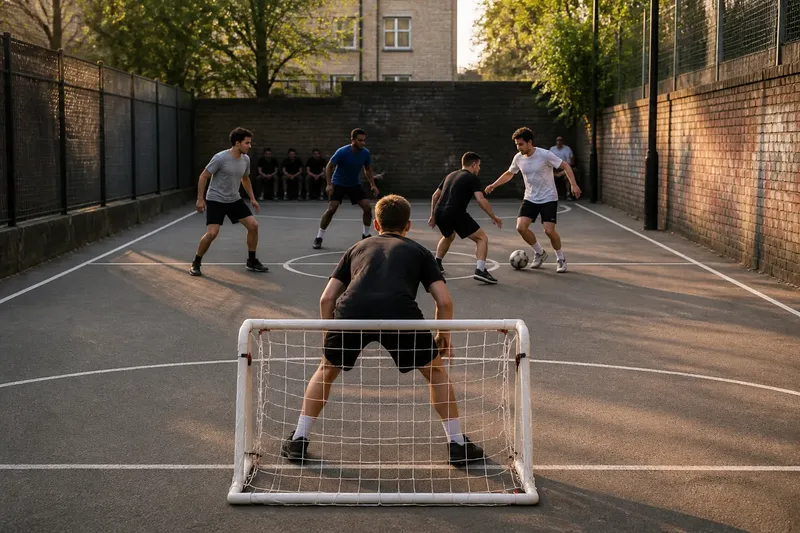
Purpose-built courts gave some urban games a more legible setting. Marked boundaries and fixed goals could make it easier for players to return to the same place and organise recurring matches. Small-sided formats also suited contained spaces without requiring a full-sized pitch.
A court did not automatically turn informal play into a league, nor did it make the game less local. A public facility might host a casual kickabout, a regular group or a scheduled competition. The venue is one part of the story; the organisation around it is another.
Say a group of friends wants to play after school and has access to a neighbourhood court. They meet there regularly, bring a ball and choose teams as they arrive, but do not register a club or arrange fixtures with other groups. The resulting game is recurring and tied to a designated court, yet remains informal rather than a formal competition.
Names and formats
Terms such as street football, cage football, five-a-side and kickabout can point to different settings or arrangements, but their meanings are not fixed everywhere. A small-sided game describes the number of players or the scale of play more readily than it describes whether the match is casual or organised.
For a useful comparison, separate three questions: where the game takes place, how often the group meets, and whether an organisation sets the schedule or rules. A court answers the first question; regular attendance speaks to the second; a club or competition may answer the third. These features can appear in different combinations.
What do the terms mean?
Is street football always informal?
No. The phrase can describe a spontaneous kickabout or a recurring small-sided game. Whether it is organised depends on arrangements such as scheduled fixtures, a club structure or a regular group.
Did courts replace street games?
There is no single replacement story that fits every city. A designated court can coexist with informal play in other shared spaces, and the same court can serve different kinds of games.
Is five-a-side the same as street football?
Not necessarily. Five-a-side refers to a format with a particular team size, while street football can refer more broadly to informal or organised urban play. A five-a-side match may be organised in a formal venue or played casually.
What makes a game formal?
Formal organisation may involve a club, scheduled fixtures or a competition with established rules. A group that meets regularly is not automatically a formal league, even if its members share familiar routines.
Reading a local tradition
To understand a local match, attend to its setting and organisation rather than assuming that its name tells the whole story. A public court with fixed goals might support open, changing teams; a regular group in an unmarked space might have a stable membership and routine. Neither arrangement alone defines the wider history of the city.
One everyday analogy helps: a tablecloth can mark out a dining place, but it does not decide who sits there or what the meal becomes. In the same way, lines and goals make a court recognisable, while the people who gather there shape its social character.
Street football history is most useful when it keeps those distinctions visible. A court can show how space was made available for recurring play, while an informal kickabout shows how football can take shape without that infrastructure. The local terms people use, and the way they organise a game, offer the clearest account of what each place has made of the sport.